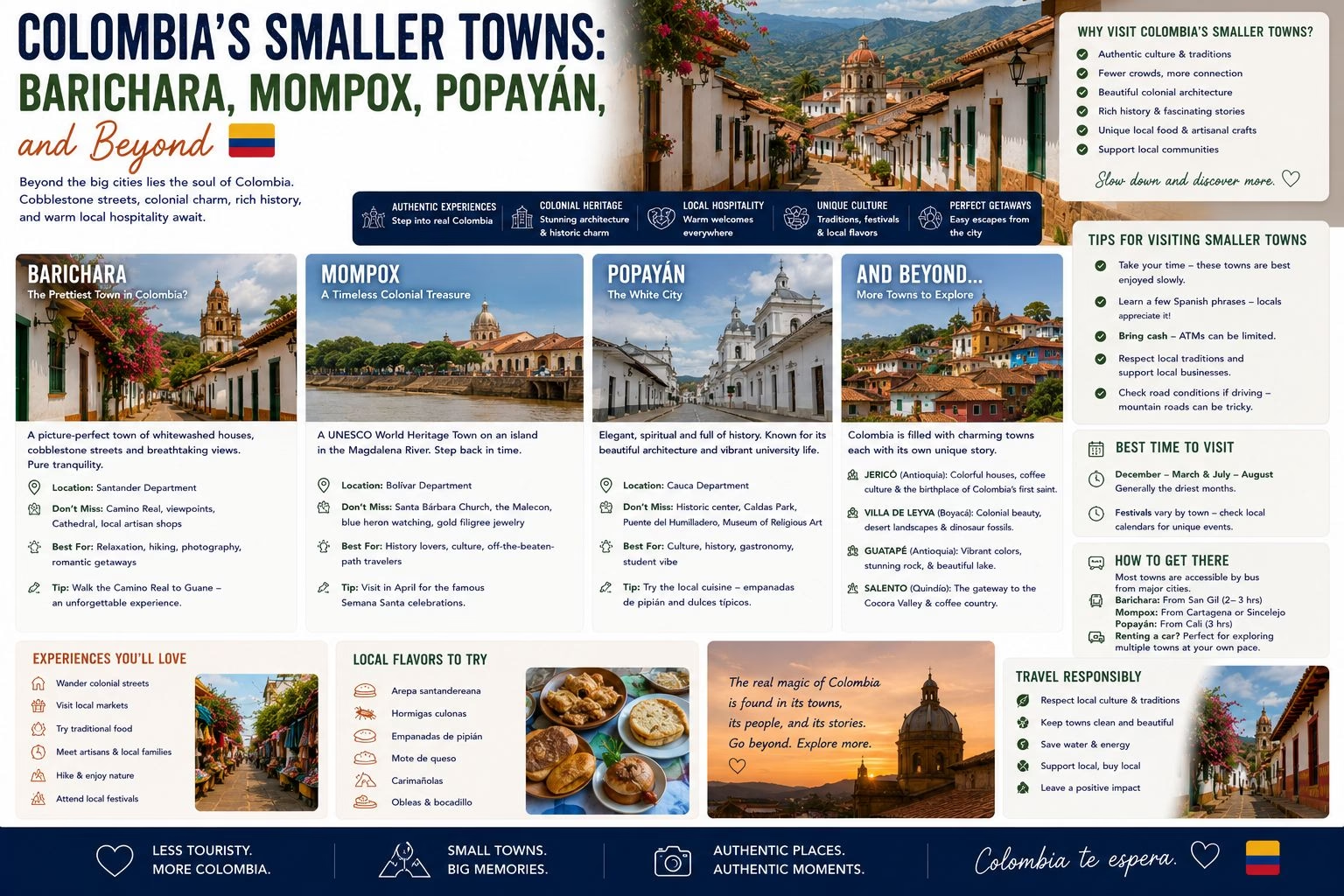
Some of the most rewarding experiences in Colombia happen not in the major cities but in the smaller colonial towns that preserve the country’s architectural and cultural heritage at a pace and scale that the cities cannot. Barichara, Mompox, Popayán, Villa de Leyva, and San Gil each offer a fundamentally different Colombia experience from Medellín or Cartagena; collectively, they make a case for slowing down and staying in one place longer than the typical urban circuit allows.
Barichara: The Most Beautiful Town in Colombia
Barichara, in the Santander department three hours from Bucaramanga, is regularly described as the most beautiful town in Colombia and has a legitimate claim to the title. The town, founded in 1705, is built almost entirely in its original ochre stone; the streets are paved with the same pale stone as the colonial churches and the single-story houses, giving the entire town a visual coherence and warmth that is unlike any other place in Colombia.
The town sits on a cliff above the Chicamocha Canyon, with views over the canyon that are extraordinary in the late afternoon light. The Camino Real, a pre-Columbian and colonial trail that descends from Barichara to the town of Guane (3 kilometres, 45 to 60 minutes of walking), is one of the finest short walks in Colombia: the stone-paved path, the canyon views, and the arrival in the smaller and quieter Guane are all worth experiencing.
Barichara is small (population around 8,000) and the main street takes 20 minutes to walk end to end. Plan for 2 to 3 nights: one day to explore the town and walk to Guane, one day for the Chicamocha Canyon viewpoints, and a slow final morning before departure.
Getting there: Fly to Bucaramanga (BGA) from Bogotá or Medellín; bus from Bucaramanga to San Gil (2 hours), then bus to Barichara (45 minutes). Alternatively, the adventure: San Gil is also Colombia’s adventure sports capital (white-water rafting, paragliding, rappelling), making a Barichara trip easily combined with a San Gil adventure day.
Mompox: The Living Colonial City
Mompox (or Momposina) is one of the most significant and most isolated colonial cities in the Americas. Founded in 1537 on an island in the Magdalena River, it served as a major commercial hub in the colonial economy; Simón Bolívar recruited troops here for the independence campaigns and it has a specific place in Colombian history. Gabriel García Márquez set part of his writing here, and the town appears in “Love in the Time of Cholera.”
The isolation that allowed Mompox to preserve its colonial fabric (it was bypassed by the main transport routes during the 20th century) is also the practical challenge of visiting: getting there requires a flight to either Barranquilla or Cartagena and then a combination of bus and boat (4 to 6 hours total depending on the route). Once there, however, the reward is a genuinely intact colonial riverfront: 400-year-old houses with wooden balconies overlooking the river, churches of exceptional quality, streets with minimal modern intrusion, and a specific atmosphere of historical weight.
The Semana Santa (Holy Week) celebration in Mompox is considered the most solemn and most beautiful in Colombia, drawing visitors from across the country and internationally. At other times of year, the town is quiet to the point of sleepiness; whether this is a feature or a bug depends entirely on what you are looking for.
Popayán: The White City
Popayán, capital of the Cauca department in southern Colombia, is nicknamed the Ciudad Blanca (White City) for the whitewashed colonial buildings that give its historic centre a distinctive appearance quite different from the coloured towns of the Andes. At 1,737 metres in a valley surrounded by volcanoes, it has a cool, misty character and a specifically intellectual history: it was one of the most important cities in the colonial era and produced an extraordinary number of Colombian political and intellectual figures.
The historic centre has extraordinary churches (the Catedral de Nuestra Señora de la Asunción, the Iglesia de San Francisco) and the Casa Museo Mosquera covers the role of the Mosquera family in Colombian independence. The Popayán gastronomy is distinct and excellent: the city is one of the country’s most celebrated for traditional food (it was the first UNESCO Creative City of Gastronomy in Colombia) and the specific dishes of the region, including empanadas de pipián, tamales, and the various preparations of mote (a corn-based preparation), are worth seeking out.
Getting there: Flights to Guillermo León Valencia Airport (PPN) from Bogotá and Medellín; bus connections to Cali (3 hours) and to the south toward Ecuador.
Villa de Leyva: The Fossil Town
Villa de Leyva, three hours from Bogotá in the Boyacá department, has one of the largest and best-preserved colonial central plazas in all of South America: the Plaza Mayor, roughly 120 metres per side, is paved with stone cobblestones and surrounded by 16th-century whitewashed colonial buildings. The scale is theatrical; the square was designed for large gatherings and military reviews and retains that quality of generous public space.
The surrounding region is notable for its extraordinary fossil record: the marine sediments of what was once a shallow sea now exposed in the desert-like hillsides around the town contain the remains of plesiosaurs, marine crocodilians, and other Cretaceous marine animals. The Museo el Fossil near the town has the most significant finds.
Villa de Leyva works well as a 2-day trip from Bogotá: 3 hours by bus each way, a night in the town, and the combination of the colonial centre with the fossil sites and the landscape of the Boyacá highlands. See the best time to visit guide when weighing a smaller-towns detour against the main circuit.
Related: Destinations Hub | Safety | Plan Your Trip | Best Time to Visit
Why the Smaller Towns Deserve More Attention
The smaller Colombian towns represent a version of the country that the main three-city circuit does not show: slower, more historically intact, and more representative of Colombian culture outside the export-facing tourist experience. The visitors who consistently describe the deepest Colombia experiences are often those who spent three days in Barichara or Mompox rather than a third city on the standard circuit.
The practical obstacle is transport: the smaller towns require more specific planning to reach than the cities, and the tourist infrastructure in each is limited compared to the resources of El Poblado or the Walled City. But this limitation is also part of the value: the traveller who makes the effort to reach Mompox has, by definition, found something that the cruise ship day-tripper or the two-night city-hopper has not. The inaccessibility that preserved these places also, for now, keeps them from being overwhelmed by the volume of tourism that has changed the character of more accessible destinations.
For Colombia visitors planning a second or third trip: the smaller towns, particularly Barichara and Mompox, consistently appear in the shortlist of experiences most worth returning for.