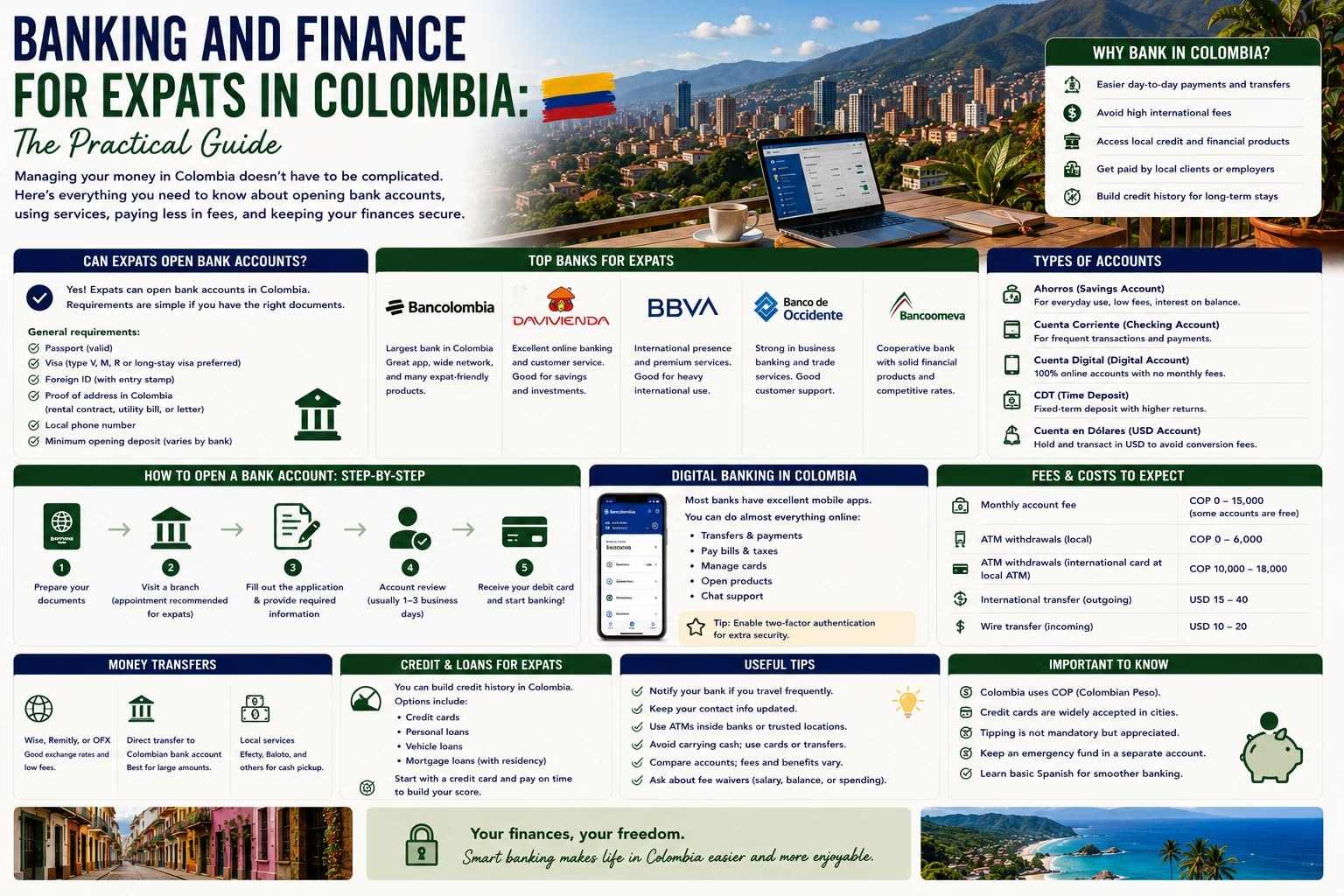
Banking is one of the most discussed practical challenges of long-term life in Colombia for foreigners. Colombian banks are legally permitted to open accounts for foreigners with appropriate documentation, but the process is significantly more complex than in most Western countries, and the specific requirements vary by bank and can change. This guide covers the options, the strategies, and the specific products that the expat community has found most useful.
Why Banking in Colombia Is Challenging for Foreigners
The complexity comes from several overlapping factors. Colombian anti-money laundering regulations require extensive documentation for account opening; the requirements for foreigners are stricter than for Colombian nationals. Some banks have, at various points, been reluctant to open accounts for foreigners specifically due to compliance concerns around the extended due diligence required. The result is that some banks are much more accessible to foreigners than others, and the situation changes over time.
The baseline requirement for any Colombian bank account: a valid cédula de extranjería (the Colombian foreign resident ID issued after a Visa M or Visa R is granted; see the visa and residency guide for how to get one). Tourist visa holders (Visa V) typically cannot open standard current or savings accounts.
The Most Accessible Banks for Foreigners
Bancolombia: The largest bank in Colombia and the most commonly recommended by the expat community. Has a foreigners department (División de Clientes Internacionales) and experience with non-resident accounts. Required documentation typically includes cédula de extranjería, passport, proof of address in Colombia, and declaration of source of funds. Process can take 2 to 8 weeks.
Davivienda: Another major bank with documented success for expat account openings. The requirements are similar to Bancolombia; the specific experience varies by branch.
Nequi and Daviplata: Digital banking apps from Bancolombia and Davivienda respectively, operating as simplified mobile wallets. Nequi specifically has been accessible to foreigners with only a cédula de extranjería and a Colombian phone number, with less extensive documentation than a full bank account. For day-to-day local payments, transfers, and bill payments, Nequi functions well as a complementary tool even before a full bank account is opened.
Bancamía and Cooperativa JFK: Smaller institutions that have been reported as more accessible to foreigners in some periods; worth checking with current expat community experience.
The Strategy Before a Colombian Account Is Open
For the period between arriving in Colombia and opening a Colombian account (which may take months), the practical financial strategy uses foreign accounts:
Wise (formerly TransferWise): A multi-currency account and debit card that handles currency conversion at near-interbank rates. Widely used by the expat community for ATM withdrawals in Colombia (the card works at most Colombian ATMs) and for receiving payments from foreign employers or clients. Wise’s exchange rates for COP are typically competitive.
Revolut: Similar functionality to Wise; some exchange rate advantages depending on the specific transaction.
Charles Schwab Bank (US account holders): The Schwab High Yield Investor Checking account reimburses all ATM fees globally; highly recommended by US-based nomads and expats for the zero-fee ATM withdrawal benefit.
Standard international cards: Work at Colombian ATMs; subject to international transaction fees (typically 1 to 3 percent) and ATM fees from both the Colombian bank and the home bank. Not the most efficient long-term solution but functional for shorter stays.
ATM Practicalities in Colombia
Colombian ATMs have withdrawal limits that are often lower than international visitors expect: typically COP 300,000 to 600,000 per transaction (approximately USD 65 to 135). Bancolombia ATMs sometimes allow higher single-transaction withdrawals; this is worth testing when withdrawing larger amounts.
The practical approach: plan for multiple withdrawals if you need a larger amount of cash, and use ATMs inside bank branches, supermarkets, or pharmacies rather than freestanding street machines. The latter have higher theft and skimming risk.
Receiving Payments from Abroad
For digital nomads and freelancers receiving foreign payments:
Wise and Payoneer are the most commonly used platforms for receiving international payments and converting to COP. Both provide receiving account details in multiple currencies (USD, EUR, GBP) that can be shared with clients or employers.
Wire transfers directly to a Colombian bank account are possible once the account is open; the exchange rates applied by Colombian banks to incoming international transfers vary and may not be as competitive as Wise or Payoneer rates. Comparing rates before each transfer is worthwhile.
Cryptocurrency: Some expats use USDT or other stablecoins as an alternative mechanism for receiving and converting income; peer-to-peer exchange platforms in Colombia allow crypto-to-COP conversion. This is an area where the legal and regulatory landscape evolves; verify the current status before using it as a primary income reception method.
Tax Considerations
Colombia taxes residents on their worldwide income once they have been in the country for more than 183 days in a 12-month period. The specific application to foreign-income earners working remotely in Colombia is a technical question that requires consultation with a qualified tax advisor familiar with both Colombian tax law and the tax treaty situation between Colombia and your home country. This is not an area where this guide can provide specific advice; professional consultation is strongly recommended for anyone staying more than 6 months.
Related: Digital Nomad Guide | Cost of Living | Visa and Residency | Expat Hub