By Trip Length
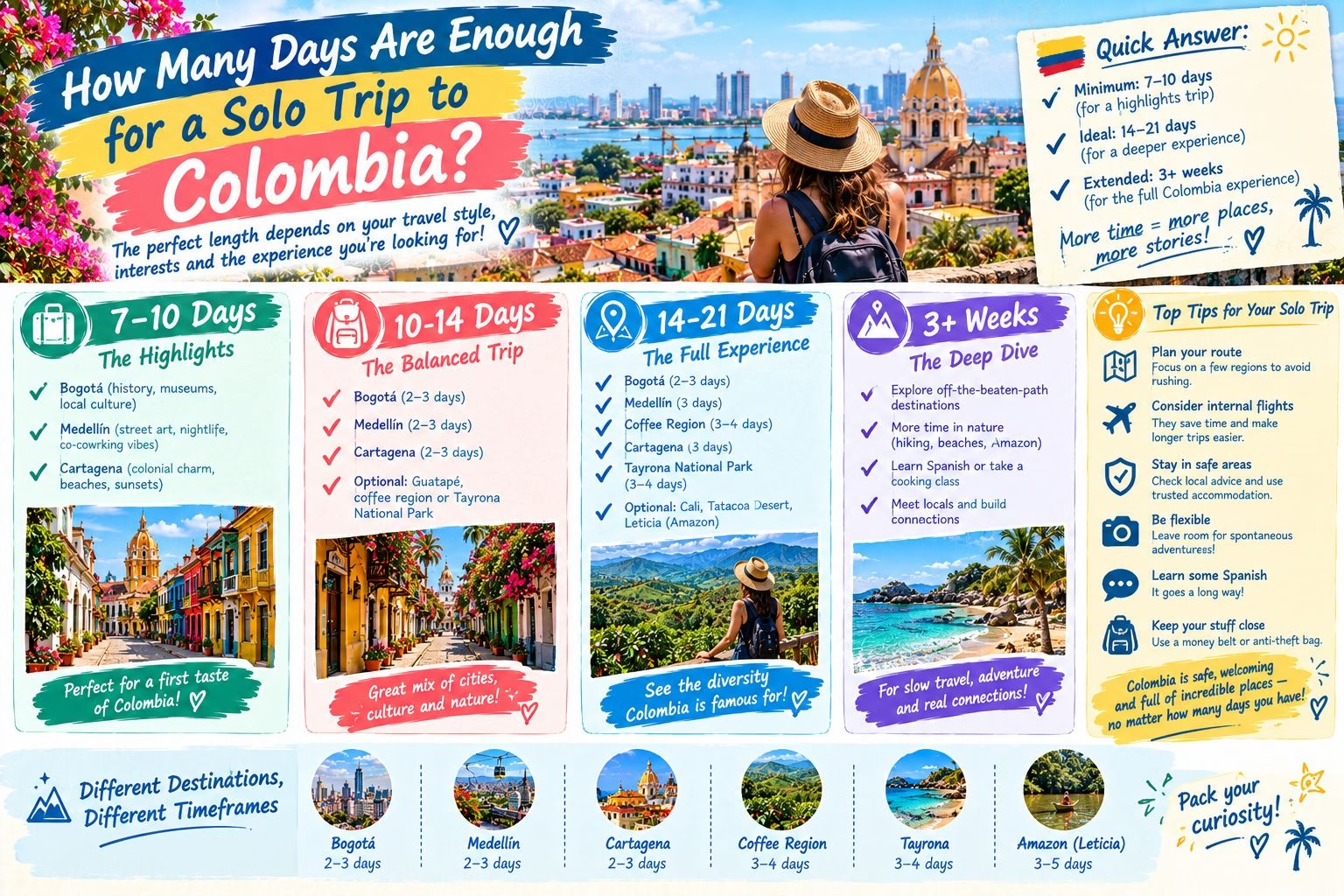
5-7 Days: One City Done Properly
Enough for one region done well rather than several done quickly. Bogotá fits comfortably into three full days (La Candelaria, the Gold Museum, Monserrate, a day trip to the Zipaquirá Salt Cathedral). Medellín fits similarly (Comuna 13, Plaza Botero, the Metrocable, a day trip to Guatapé). Cartagena benefits from four days to properly cover the Walled City, Castillo San Felipe, and a Rosario Islands excursion. Domestic flights between hubs run 1-2 hours; pick one region rather than splitting a short trip across several.10-14 Days: The Balanced Introduction
The most common and genuinely well-paced option: Bogotá (2-3 days), Medellín or the Coffee Region (3-4 days), and Cartagena or Santa Marta/Tayrona (3-4 days), with travel days built in between. This covers Colombia’s three most distinct regions, Andean capital, coffee country, Caribbean coast, without spending most of the trip in transit.3-4 Weeks: Room for the Amazon or the Pacific Coast
Remote regions add real travel time and complexity: the Amazon typically requires a flight to Leticia plus a multi-day river or jungle stay with a licensed guide; the Pacific coast requires additional travel and boat transfers, especially relevant if you’re timing a visit around whale-watching season (roughly July-October). A three-week plan might run 4-6 days in Bogotá and the Coffee Region, 4-6 days in Medellín or Cartagena, and a genuine 7-10 days for the Amazon or Pacific coast, with rest days built in rather than back-to-back travel.What Actually Determines the Right Length for You
- Pace preference: ticking off highlights quickly versus settling into fewer places for longer.
- Budget: more days generally means a lower cost per day, since you’re not paying a premium for compressed, flight-heavy logistics.
- Regions of real interest: the Amazon and Pacific coast specifically require more time investment than the standard Bogotá-Medellín-Cartagena circuit.
- Rest days: genuinely worth building in on any trip over a week; altitude adjustment in Bogotá and the physical demands of hikes like Cocora Valley or Tayrona both benefit from not being scheduled back-to-back with travel days.
Practical Planning Notes
Book internal flights early for better prices, and build in a buffer day for flight delays or altitude adjustment when you first arrive in Bogotá. For overland transfers longer than four hours, weigh the time saved by a short domestic flight against the cost, it’s often worth it on a shorter trip and less necessary on a longer, slower one.To Wrap Up
A week is enough to properly experience one Colombian city and its surroundings. Two weeks lets you cover the country’s three signature regions at a comfortable pace. Three to four weeks opens up the Amazon and the Pacific coast, both worth the extra time if they’re genuinely on your list. There’s no wrong length here, the question is really which regions matter most to you and how much transit time you’re willing to trade for breadth.FAQ
Q: How many days are enough for a short solo trip to Colombia?
A: 5-7 days is enough for one major city and a nearby day trip done properly: three days in Bogotá or Medellín, or four in Cartagena. Domestic flights run 1-2 hours between hubs, so on a short trip, pick one region rather than splitting your time across several.Q: What’s the ideal length to see Colombia’s main highlights?
A: 10-14 days, covering Bogotá, Medellín or the Coffee Region, and Cartagena or Santa Marta/Tayrona at a comfortable pace with travel days built in between each.Q: How long should I plan for a trip that includes the Amazon or Pacific coast?
A: Three to four weeks, since both regions require significant additional travel time and are genuinely worth doing slowly rather than rushed. A month total lets you combine the standard circuit with a real 7-10 day stay in one of these remote regions rather than a token visit.Sample Itineraries by Length
A week is enough to see one or two regions, for example Bogotá and Medellín, or Cartagena and a nearby island. Two weeks allows a more balanced route that might include a city, the Coffee Region and the Caribbean coast, with time to rest. Three weeks or more lets you add hikes, remote areas and slower days without rushing.
Travel Time Is Longer Than It Looks
Colombia’s mountains mean that overland journeys can take much longer than distance suggests, and flights between major cities are often the most efficient way to cover long distances. Build in buffer days for delays, weather and fatigue, and avoid changing accommodation every night. Our guide to how to get around Colombia alone compares transport options.
Factors That Affect How Long to Stay
- Your budget and how much you want to spend per day.
- Your pace, whether you prefer many stops or fewer, longer stays.
- Your interests, such as hiking, beaches, food, culture or remote work.
- The season and the weather in the regions you plan to visit.
- Visa rules and how long you are allowed to stay as a visitor.
Slow Travel and Longer Stays
Solo travelers often discover that staying longer in fewer places leads to better experiences, friendships and savings. A month in one or two cities allows you to join classes, volunteer or work remotely. Check the rules for how long you may stay as a visitor and what to do if you want to extend, as covered in our guide to visa requirements for solo travelers.
Planning Your Budget and Timing
Longer trips cost more overall but can lower the daily average through cheaper long stays and fewer transfers. Plan your budget with our solo travel budget guide and choose your dates using the guide to the best time to visit.
Building in Rest Days
Plan a lighter day after long travel, a hike or a late night, and avoid packing every day with activities. Rest days give you time for laundry, planning and spontaneous discoveries, and they help you adjust to altitude and heat.

I’m Luciana, a travel writer from Bogotá, Colombia, and yes, I know exactly what it’s like to be a solo female traveler in a country the world still misunderstands.
I’ve been travelling independently for 10 years, completing 50+ solo trips across Colombia, Mexico, Central America, Argentina, Peru and the United States. I write in both English and Spanish, and I also contribute to allaboutcolombia.com where I cover my home country in depth — from the coffee region to the Caribbean coast to the Andes.
My speciality is Latin America: the neighbourhoods the guidebooks skip, the buses that are actually fine to take, the hostels that feel like home, and the restaurants where locals actually eat. I’ve hitchhiked across Patagonia, navigated Medellín’s metro system at rush hour, and camped solo in the Sierra Nevada de Santa Marta. I know this region the way you only can when it’s yours.
I also cover the US for solo travelers, having spent time road-tripping through the Southwest, the Pacific Coast and the Deep South.