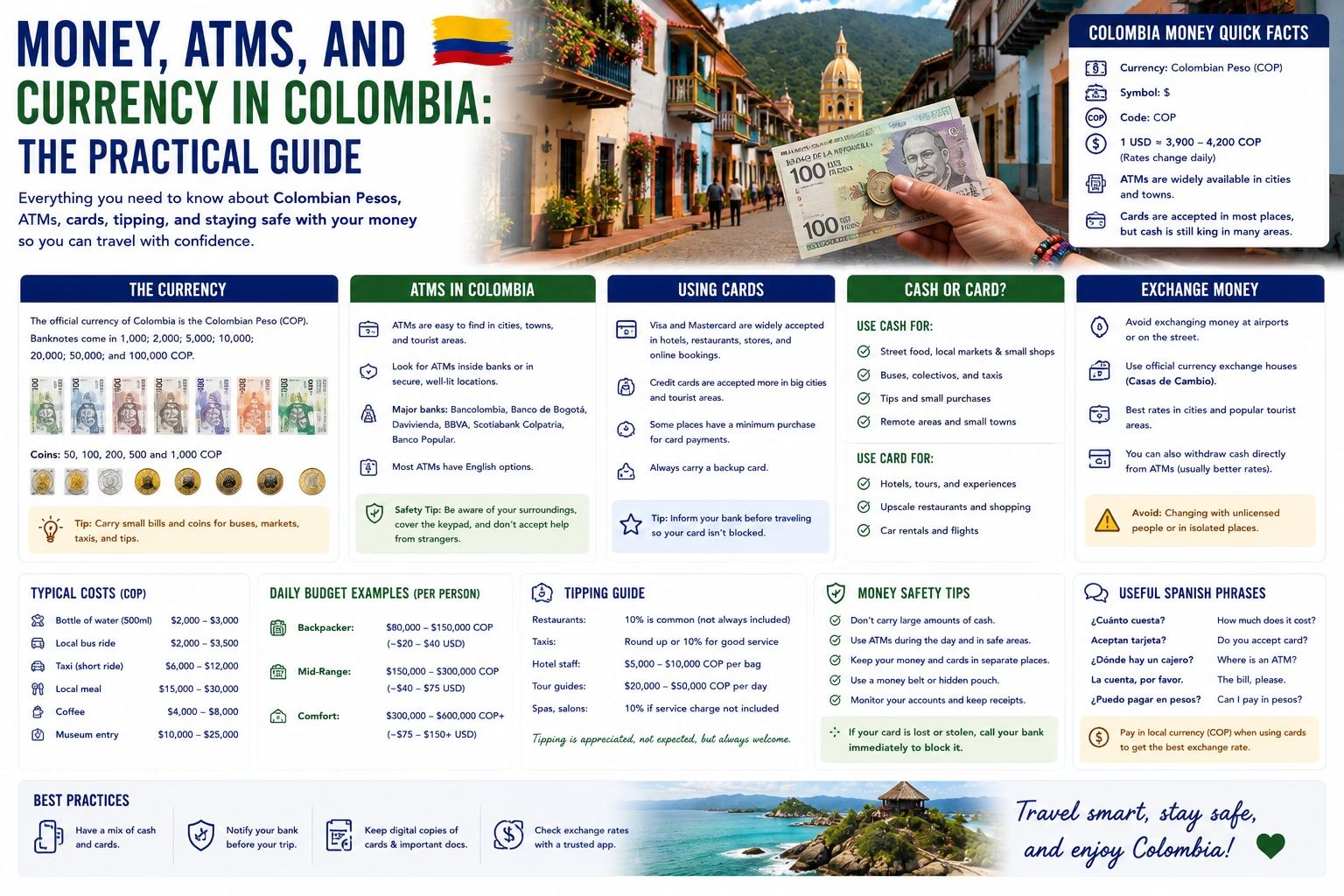
Managing money in Colombia is straightforward in most situations, with a few specific considerations that are worth knowing before arrival. This guide covers the currency, how to access pesos, the card acceptance landscape, and what to know about the specific situations that catch travellers out.
The Colombian Peso (COP)
Colombia’s currency is the Colombian peso, abbreviated COP or sometimes written as $ within Colombia (which can be confusing alongside USD references). Current exchange rates place 1 USD at approximately 4,000 to 4,500 COP and 1 GBP at approximately 5,000 to 5,500 COP; verify the current rate before travel as this fluctuates.
The large numbers involved in Colombian prices trip up visitors initially: 50,000 pesos sounds like a lot and is about USD 11 to 12. A hotel room for 300,000 pesos per night is approximately USD 65 to 75. Getting comfortable with the scale of the numbers is one of the first practical adaptations Colombia requires.
ATMs: The Most Convenient Access to Pesos
ATMs are widely available in Colombian cities and towns. The major Colombian banks with ATM networks include Bancolombia, Banco de Bogotá, Davivienda, and Banco de Occidente. International cards (Visa and Mastercard) work at most ATMs; American Express has more limited acceptance.
Withdrawal limits: Colombian ATMs have transaction limits that are often lower than international visitors expect, typically 300,000 to 600,000 COP per transaction (roughly USD 65 to 135). Planning for multiple withdrawals or using ATMs that allow larger transactions (Bancolombia machines often have higher limits) is advisable.
ATM fees: Foreign-issued cards pay both the Colombian bank’s international transaction fee and any fee charged by their home bank. Using a card that reimburses international ATM fees (some travel-oriented bank accounts) reduces this cost significantly.
Security: Use ATMs inside banks, shopping centres, or pharmacies (droguerías) rather than standalone street machines. Cover the keypad when entering your PIN. Distraction theft at ATMs is a known tactic in some Colombian cities.
Card Acceptance
Card acceptance in Colombia is good in urban tourist areas and most mid-range and above businesses. Specific contexts where cash is essential:
Local restaurants and tiendas (corner shops): often cash only
Markets and street food: cash only
Rural areas and smaller towns: often cash only or very limited card acceptance
Some transportation: taxis often prefer cash; Transmilenio in Bogotá and the Medellín metro use rechargeable cards or cash
In Medellín’s El Poblado, Bogotá’s Zona Rosa and Chapinero, and Cartagena’s Walled City, card acceptance is broad. Away from these tourist-oriented areas, cash is more necessary.
Contactless and mobile payments: Nequi and Daviplata are Colombian mobile payment apps used for transfers; they are less relevant for tourists but worth knowing about for longer stays.
Cash Management: How Much to Carry
The appropriate amount of cash to carry depends on your daily activities. A general rule: keep enough for one to two days of spending in smaller denominations, plus a buffer for situations where cards are not accepted. Carrying very large amounts of cash increases both the financial and personal safety risk of theft.
Denomination practicalities: 50,000 COP notes (the highest denomination) can be difficult to break at small establishments. Carry a mix of 10,000, 20,000, and 50,000 notes. 1,000 COP and 2,000 COP coins are useful for small purchases and market food.
USD Cash: Worth Bringing Some
USD in good physical condition is useful in Colombia for two reasons: it can be exchanged at casas de cambio (currency exchange offices) at generally competitive rates, and it is accepted directly at some tourist-facing businesses, particularly in Cartagena.
Bringing USD 200 to 400 in clean, unmarked bills gives you flexibility. Worn, torn, or marked USD notes are often rejected; bring pristine bills.
Casas de cambio are found in the main cities and airports; compare rates between several before exchanging. The airport rate is typically the least favourable.
Credit Card Fraud Awareness
Credit card skimming exists in Colombia. Using chip-and-pin or contactless rather than magnetic stripe reduces risk. Monitor your statements during and after a Colombia trip.
The most significant financial scam targeting tourists is not credit card fraud but rather overcharging at tourist-facing businesses. Always ask for a price before ordering or accepting a service; always check itemised bills in restaurants. The common scams guide covers the specific patterns to watch for.
Tipping in Colombia
Tipping is expected but the culture differs from North America. The details are in the full tipping guide; the quick summary:
At restaurants, a 10 percent service charge (propina) is often added to the bill automatically and will be listed as a separate line item. This is a voluntary charge in Colombia (not legally compulsory), but declining it is unusual and somewhat awkward. Check your bill and understand what you are paying.
For guides, drivers, porters, and hotel staff, tips are expected and appreciated. Amounts of USD 2 to 5 for short services and USD 5 to 15 for full-day guides are appropriate.
Related: Plan Your Trip | Budget Guide | Safety | Visa
The Nequi App: Colombia’s Most Useful Financial Tool for Visitors
Nequi, the digital wallet app from Bancolombia, has become one of the most practically useful financial tools for longer-stay Colombia visitors. The app allows:
Receiving payments from other Nequi accounts (most Colombians have one, and paying for services via Nequi transfer has become standard)
Paying QR codes at restaurants, shops, and markets that accept digital payment
Withdrawing cash at Bancolombia ATMs without card fees (for Nequi accounts)
Receiving transfers from international accounts in some configurations
Opening a Nequi account requires a Colombian phone number and some identification; the process has been accessible to foreigners in many cases without the full documentation required for a traditional bank account. Checking current requirements directly at nequi.com.co is advisable.
Understanding Your Bills: The IVA and the Propina
Two line items on Colombian restaurant bills that catch visitors out:
IVA (Impuesto al Valor Agregado): Colombia’s VAT, currently 19 percent for most restaurant and service consumption. This is often not included in the menu price and appears as a separate line on the bill. Always ask whether prices are con IVA o sin IVA when the amount matters.
Propina: The voluntary service charge (typically 10 percent) added separately to restaurant bills. See the full tipping guide for how this works. The key point: it is voluntary by law but paying it is the social norm.
Including both IVA and propina can add nearly 30 percent to the stated menu price. Always check whether the menu prices are already inclusive or exclusive of these charges before committing to a restaurant based on the menu price.
Cash Advance Timing: Avoiding the Trap
Colombian ATMs are offline during certain hours at some banks, and some machines run out of cash on Friday afternoons before long weekends when many Colombians are also withdrawing cash. Planning cash withdrawals for the middle of the week, during banking hours, from machines inside bank branches rather than freestanding kiosks, reduces the chance of finding an empty or offline machine when you most need it.