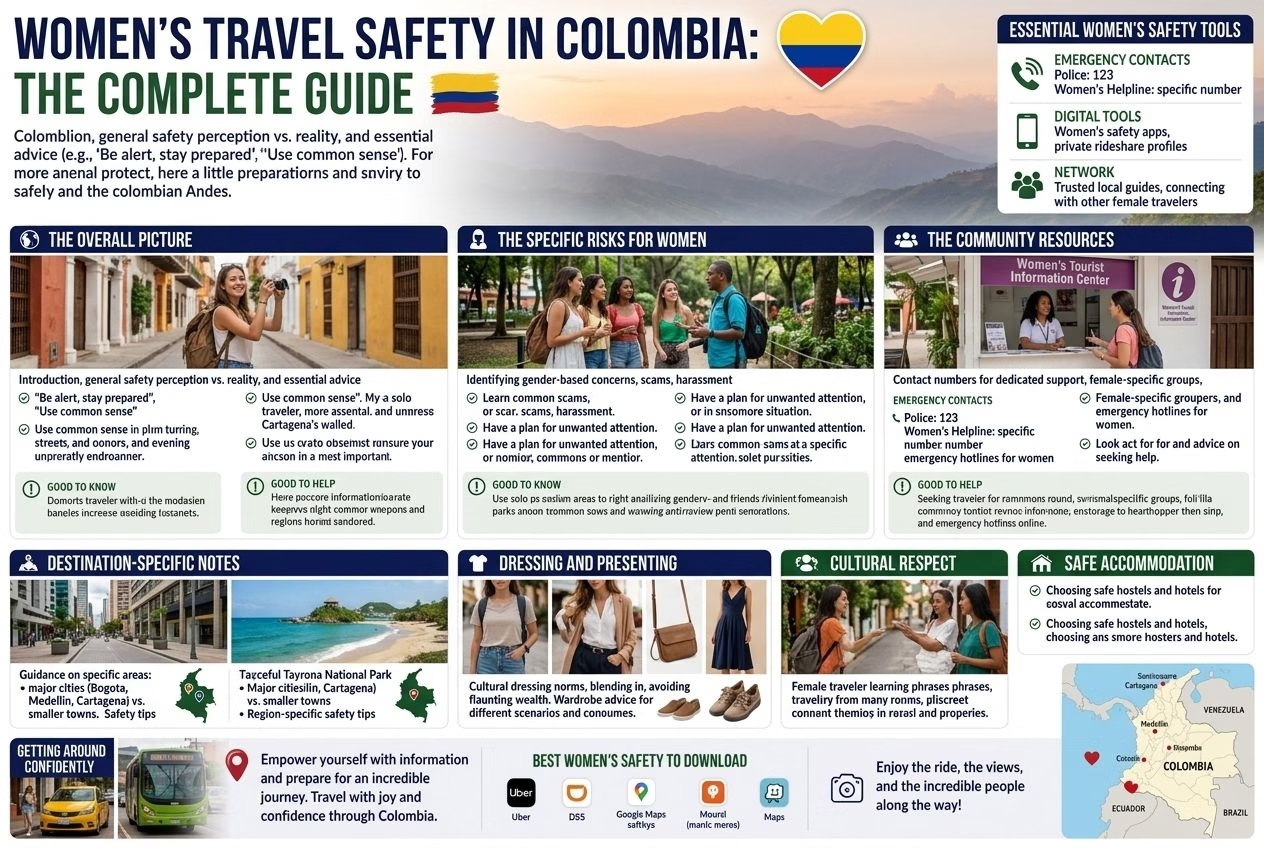
Colombia is a viable and frequently visited destination for solo women travellers; it is also a destination that requires specific preparation around certain risks that disproportionately affect women. This guide covers the practical picture honestly: what the actual risks are, where they are highest, and the specific practices that the established solo women’s travel community in Colombia consistently recommends.
The Overall Picture
The large and active community of solo women travellers in Colombia reports experiences that are broadly positive. The cities that most women visit (Medellín, Cartagena, the Coffee Region) are manageable with appropriate awareness. Colombian men’s social culture includes a degree of attention to women that is more overt than in Northern Europe or North America; most of it is verbal and benign, though persistent and occasionally tiresome. Serious harassment and assault do occur and the risks are not trivial; they are also specific and manageable.
The scopolamine risk has a specific dimension for women: sexual assault facilitated by the drug is documented in Colombia, with the bar and club environment as the most common setting. This is the most serious specific safety concern for women in Colombia’s tourist areas and the one that most requires specific precautions.
The Specific Risks for Women
Scopolamine-facilitated assault: The drink-spiking risk discussed in the scams guide applies to all tourists but has specifically documented sexual assault dimensions affecting women. The precautions are the same: never leave a drink unattended, be cautious about accepting drinks from people met recently, have a plan for getting home safely before the evening starts, and be aware of any unusual disorientation as a possible warning sign.
Street harassment (piropo culture): Verbal commentary from men on the street, varying from complimentary to unwanted. In most tourist areas of Medellín and Cartagena, this is relatively low-level; it is more persistent in some neighbourhoods and at certain times of day. The established response of ignoring and continuing without eye contact or engagement is the most effective; engaging, even negatively, tends to extend the interaction.
Taxis: The unofficial taxi risk, documented for all tourists, has a specific dimension for women travelling alone at night. Using app-based ride services is particularly important for women in this context.
The Community Resources
The community of solo women travellers in Colombia is large and actively shares information through:
Girls Love Travel (Facebook group), with a Colombia-specific search function for current reports.
The r/solotravel subreddit, with many threads specifically about Colombia from women’s perspectives.
Solo Female Traveler Network (solofemaletraveler.com), which has Colombia-specific content.
These resources, which provide current community intelligence, are among the most valuable sources of practical, up-to-date information available. Reading recent posts before travel gives you a more accurate current picture than any guide written in advance.
Destination-Specific Notes
Medellín: The El Poblado hostel culture is well-established and many solo women base themselves here specifically because of the social infrastructure. See the El Poblado guide for the neighbourhood picture. The specific risks (scopolamine in bars, street harassment in some areas) require the precautions described; the day-to-day experience of the neighbourhood for most women is positive.
Cartagena: The tourist areas of the Walled City and Getsemaní are visited by large numbers of solo women; it is one of the more common solo women’s travel destinations in Colombia. The “friendly stranger” approach (described in the scams guide) has a specific gendered dimension in Cartagena; awareness of the pattern is the primary protection.
The Coffee Region (Salento): Consistently described as one of the most welcoming and safe Colombia destinations for solo women. The small-town character, the hostel social scene, and the day activities (Cocora Valley, finca visits) all make it an excellent destination.
Bogotá: Requires more specific awareness than the other destinations; the nightlife situation and the transport risks are more complex. Sticking to the established tourist neighbourhoods (Chapinero, Zona Rosa, Usaquén), using app-based transport exclusively, and being more cautious about evening activities than in Medellín or Salento is the consistent recommendation.
Dressing and Presenting
Colombian women in the major cities dress with considerable style and generally show more skin than is common in Northern European or North American casual dress. The idea that covering up prevents harassment is largely inaccurate in Colombia; the locals dress vibrantly and there is no obvious correlation between dress and harassment levels in the tourist areas. Dress in a way that is comfortable for you and appropriate to the activity.
Related: Solo Travel Safety | Safety Hub | Is Colombia Safe? | Scams Guide